集合
目录
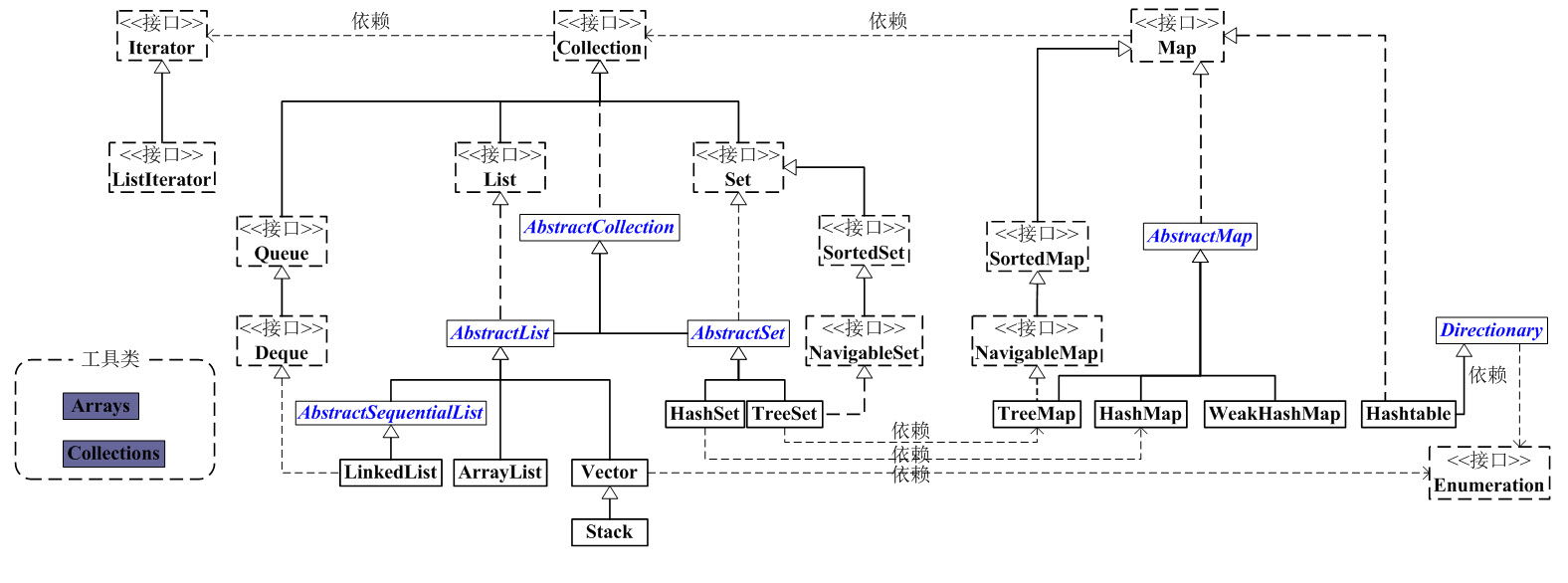
集合的整体框架
2.List
List是一个继承于Collection的接口,即List是集合中的一种。List是有序的队列,List中的每一个元素都有一个索引;第一个元素的索引值是0,往后的元素的索引值依次+1。和Set不同,List中允许有重复的元素。
2.1ArrayList
ArrayList实现List接口,底层使用数组保存所有的元素。其操作基本上是对数组的操作。
2.1.1构造方法
public ArrayList () {
this . elementData = DEFAULTCAPACITY_EMPTY_ELEMENTDATA ;
}
//创建指定容量的List
public ArrayList ( int initialCapacity ) {
if ( initialCapacity > 0 ) {
this . elementData = new Object [ initialCapacity ] ;
} else if ( initialCapacity == 0 ) {
this . elementData = EMPTY_ELEMENTDATA ;
} else {
throw new IllegalArgumentException ( "Illegal Capacity: " +
initialCapacity );
}
}
public ArrayList ( Collection <? extends E > c ) {
elementData = c . toArray ();
if (( size = elementData . length ) != 0 ) {
// c.toArray might (incorrectly) not return Object[] (see 6260652)
if ( elementData . getClass () != Object [] . class )
elementData = Arrays . copyOf ( elementData , size , Object [] . class );
} else {
// replace with empty array.
this . elementData = EMPTY_ELEMENTDATA ;
}
}
2.1.2添加元素
ArrayList提供了下列方法进行添加元素。
public E set\(int index, E element\)
//用指定的元素替代此列表中指定位置上的元素,并返回以前位于该位置上的元素。
public E set ( int index , E element ) {
rangeCheck ( index );
E oldValue = elementData ( index );
elementData [ index ] = element ;
return oldValue ;
}
E elementData ( int index ) {
return ( E ) elementData [ index ] ;
}
public boolean add\(E e\)
//将指定的元素添加到此列表的末尾
public boolean add ( E e ) {
ensureCapacityInternal ( size + 1 ); // Increments modCount!!
elementData [ size ++] = e ;
return true ;
}
public void add\(int index, E element\)
// 将指定的元素插入此列表中的指定位置。
// 如果当前位置有元素,则向右移动当前位于该位置的元素以及所有后续元素(将其索引加1)。
public void add ( int index , E element ) {
if ( index > size || index < 0 )
throw new IndexOutOfBoundsException ( "Index: " + index + ", Size: " + size );
// 如果数组长度不足,将进行扩容。
ensureCapacity ( size + 1 ); // Increments modCount!!
// 将 elementData中从Index位置开始、长度为size-index的元素,
// 拷贝到从下标为index+1位置开始的新的elementData数组中。
// 即将当前位于该位置的元素以及所有后续元素右移一个位置。
System . arraycopy ( elementData , index , elementData , index + 1 , size - index );
elementData [ index ] = element ;
size ++ ;
}
System提供的静态方法arraycopy(),我们可以使用它来实现数组之间的复制。
方法签名public static native void arraycopy\(Object src, int srcPos, Object dest, int destPos, int length\) ;
src:源数组
srcPos:源数组要复制的起始位置
dest:目标数组
destPos:目标数组放置的起始位置,
length:复制的长度
int [] array1 = { 1 , 2 , 3 , 4 , 5 , 6 };
int [] array2 = { 5 , 4 , 3 , 2 , 1 };
System . arraycopy ( array1 , 0 , array2 , 1 , 2 );
for ( int i = 0 ; i < array2 . length ; i ++ ) {
System . out . println ( array2 [ i ] );
}
// 5
// 1
// 2
// 2
// 1
这个函数也可以实现自己到自己的复制。
int [] array1 = { 1 , 2 , 3 , 4 , 5 , 6 };
System . arraycopy ( array1 , 0 , array1 , 3 , 3 );
for ( int i = 0 ; i < array1 . length ; i ++ ) {
System . out . println ( array1 [ i ] );
}
// 1
// 2
// 3
// 1
// 2
// 3
// 按照指定collection的迭代器所返回的元素顺序,将该collection中的所有元素添加到此列表的尾部。
public boolean addAll ( Collection <? extends E > c ) {
Object [] a = c . toArray ();
int numNew = a . length ;
ensureCapacity ( size + numNew ); // Increments modCount
System . arraycopy ( a , 0 , elementData , size , numNew );
size += numNew ;
return numNew != 0 ;
}
2.1.3获取
// 返回此列表中指定位置上的元素。
public E get ( int index ) {
RangeCheck ( index );
return ( E ) elementData [ index ] ;
}
2.1.4删除
ArrayList提供了根据下标或者指定对象两种方式的删除功能。
// 移除此列表中指定位置上的元素。返回删除的元素
public E remove ( int index ) {
RangeCheck ( index );
modCount ++ ;
E oldValue = ( E ) elementData [ index ] ;
int numMoved = size - index - 1 ;
if ( numMoved > 0 )
System . arraycopy ( elementData , index + 1 , elementData , index , numMoved );
elementData [-- size ] = null ; // Let gc do its work
return oldValue ;
}
// 移除此列表中首次出现的指定元素(如果存在)。这是应为ArrayList中允许存放重复的元素。
public boolean remove ( Object o ) {
// 由于ArrayList中允许存放null,因此下面通过两种情况来分别处理。
if ( o == null ) {
for ( int index = 0 ; index < size ; index ++ )
if ( elementData [ index ] == null ) {
// 类似remove(int index),移除列表中指定位置上的元素。
fastRemove ( index );
return true ;
}
} else {
for ( int index = 0 ; index < size ; index ++ )
if ( o . equals ( elementData [ index ] )) {
fastRemove ( index );
return true ;
}
}
return false ;
}
2.1.5其他常用方法
public int indexOf\(Object o\)
//返回指定元素第一次出现的索引,如果没有该元素返回-1
public int indexOf ( Object o ) {
if ( o == null ) {
for ( int i = 0 ; i < size ; i ++ )
if ( elementData [ i ]== null )
return i ;
} else {
for ( int i = 0 ; i < size ; i ++ )
if ( o . equals ( elementData [ i ] ))
return i ;
}
return - 1 ;
}
public int lastIndexOf\(Object o\)
//返回指定元素最后一次出现的索引,如果不存在该元素返回-1
public int lastIndexOf ( Object o ) {
if ( o == null ) {
for ( int i = size - 1 ; i >= 0 ; i -- )
if ( elementData [ i ]== null )
return i ;
} else {
for ( int i = size - 1 ; i >= 0 ; i -- )
if ( o . equals ( elementData [ i ] ))
return i ;
}
return - 1 ;
}
public Object[] toArray()
//将ArrayList转换为数组
public Object [] toArray () {
return Arrays . copyOf ( elementData , size );
}
public T[] toArray\(T\[\] a\)
public < T > T [] toArray ( T [] a ) {
if ( a . length < size )
//当数组长度小于集合长度创建一个新的数组,并且复制集合里的所有元素
// Make a new array of a's runtime type, but my contents:
return ( T [] ) Arrays . copyOf ( elementData , size , a . getClass ());
//当数组长度大于等于集合长度,将集合中的所有元素复制到集合里
System . arraycopy ( elementData , 0 , a , 0 , size );
if ( a . length > size )
a [ size ] = null ;
return a ;
}
//清除所有元素
public void clear () {
modCount ++ ;
// clear to let GC do its work
for ( int i = 0 ; i < size ; i ++ )
elementData [ i ] = null ;
size = 0 ;
}
2.1.6遍历
遍历可以通过for循环,foreach循环,Iterator和ListIterator四种方式进行遍历。
在foreach循环和iterator调用ArrayList的add和remove方法将会出现ConcurrentModificationException异常。所以要想遍历的时候修改集合,只能使用for循环,或者使用Iterator的remove方法。
2.2LinkedList
LinkedList是基于链表 的集合,其查询速度肯定比不上基于数组实现的集合。但是链表实现的最大优点在于,频繁的操作节点速度就比较快。
LinkedList内部有一个静态的内部类Node,代表节点。
private static class Node < E > {
E item ; //元素
Node < E > next ; //下一个节点
Node < E > prev ; //上一个节点
Node ( Node < E > prev , E element , Node < E > next ) {
this . item = element ;
this . next = next ;
this . prev = prev ;
}
}
2.2.1构造函数
public LinkedList () {
}
public LinkedList ( Collection <? extends E > c ) {
this ();
addAll ( c );
}
public boolean addAll ( Collection <? extends E > c ) {
return addAll ( size , c );
}
public boolean addAll ( int index , Collection <? extends E > c ) {
checkPositionIndex ( index );
Object [] a = c . toArray ();
int numNew = a . length ;
if ( numNew == 0 )
return false ;
Node < E > pred , succ ;
if ( index == size ) {
succ = null ;
pred = last ;
} else {
succ = node ( index );
pred = succ . prev ;
}
for ( Object o : a ) {
@SuppressWarnings ( "unchecked" ) E e = ( E ) o ;
Node < E > newNode = new Node <> ( pred , e , null );
if ( pred == null )
first = newNode ;
else
pred . next = newNode ;
pred = newNode ;
}
if ( succ == null ) {
last = pred ;
} else {
pred . next = succ ;
succ . prev = pred ;
}
size += numNew ;
modCount ++ ;
return true ;
}
2.2.2添加
//添加指定元素到末尾
public boolean add ( E e ) {
linkLast ( e );
return true ;
}
//在末尾添加节点
void linkLast ( E e ) {
final Node < E > l = last ;
final Node < E > newNode = new Node <> ( l , e , null );
last = newNode ;
if ( l == null )
first = newNode ;
else
l . next = newNode ;
size ++ ;
modCount ++ ;
}
//添加指定元素到指定位置
public void add ( int index , E element ) {
checkPositionIndex ( index );
if ( index == size )
linkLast ( element );
else
linkBefore ( element , node ( index ));
}
//根据索引返回节点
Node < E > node ( int index ) {
// assert isElementIndex(index);
if ( index < ( size >> 1 )) {
Node < E > x = first ;
for ( int i = 0 ; i < index ; i ++ )
x = x . next ;
return x ;
} else {
Node < E > x = last ;
for ( int i = size - 1 ; i > index ; i -- )
x = x . prev ;
return x ;
}
}
//指定节点前插入元素
void linkBefore ( E e , Node < E > succ ) {
// assert succ != null;
final Node < E > pred = succ . prev ;
final Node < E > newNode = new Node <> ( pred , e , succ );
succ . prev = newNode ;
if ( pred == null )
first = newNode ;
else
pred . next = newNode ;
size ++ ;
modCount ++ ;
}
//在开始位置插入指定元素
public void addFirst ( E e ) {
linkFirst ( e );
}
//在末尾插入指定元素
public void addLast ( E e ) {
linkLast ( e );
}
2.2.3删除
public E remove():删除第一个元素
public E remove () {
return removeFirst ();
}
public E remove\(int index\) :删除指定位置的元素
public E remove ( int index ) {
checkElementIndex ( index );
return unlink ( node ( index ));
}
public E remove\(int index\) :删除指定位置的元素
public E remove ( int index ) {
checkElementIndex ( index );
return unlink ( node ( index ));
}
public boolean remove\(Object o\) :删除指定元素首次出现的该元素
public boolean remove ( Object o ) {
if ( o == null ) {
for ( Node < E > x = first ; x != null ; x = x . next ) {
if ( x . item == null ) {
unlink ( x );
return true ;
}
}
} else {
for ( Node < E > x = first ; x != null ; x = x . next ) {
if ( o . equals ( x . item )) {
unlink ( x );
return true ;
}
}
}
return false ;
}
public E removeFirst() :删除第一个
public E removeLast():删除最后一个
public E poll():删除第一个
public E pollFirst() :删除第一个
public E pollLast():删除第一个
2.2.4获取
public E get\(int index\) :根据索引获取
public E getLast():获取最后一个
public E getFirst():获取第一个
public E peek():获取第一个
public E peekFirst() :获取第一个
public E peekLast():获取最后一个
2.3Vector
Vector也是基于数组实现的队列,代码和ArrayList非常相似,只不过Vector是线程同步,其执行的效率相比ArrayList就低了。
2.4Stack
Stack是栈。它的特性是:先进后出\(FILO, First In Last Out\) 。Stack是继承于Vector\(矢量队列\) 的,由于Vector是通过数组实现的,这就意味着,Stack也是通过数组实现的。
3.Set
Set是一个继承于Collection的接口,即Set也是集合中的一种。Set是没有重复元素的集合。
3.1HashSet
HashSet依赖于HashMap,它实际上是通过HashMap实现的。HashSet中的元素是无序的。
3.2TreeSet
TreeSet依赖于TreeMap,它实际上是通过TreeMap实现的。TreeSet中的元素是有序的。
参考
本节目录
September 28, 2026
May 18, 2015
GitHub